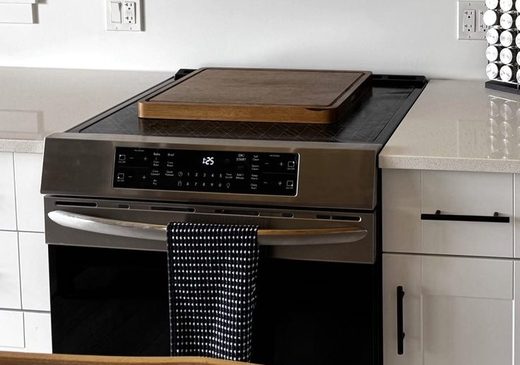
How induction is different
- It heats the pan, not the air. The ring only gets hot where a pan is sitting on it — no glow, no waiting, and it responds as fast as gas.
- The pan has to be magnetic. If a fridge magnet won't stick to the bottom, it won't work. The pans in the cottage are all induction-ready; anything you bring from home needs checking.
- Flat bottoms matter. A warped pan sits on the sensor and the ring cuts in and out — a bowed pan is the usual reason "it keeps stopping".
- Lift, don't slide. Sliding a pan scratches the glass; lifting it costs you nothing.
- The surface can still be warm from the pan sitting on it after you switch off. Treat it as hot until it isn't.
The cooking mat stays on
- Leave the mat on the cooktop while you cook. Pans sit on top of it — that's what it's for, it protects the glass, and nothing works properly with it moved to the side.
Never put a hot pot or pan down on the counter. The counters mark and blister and it can't be undone. Use the cutting board, the trivet, or leave the pan on the cooktop. This is the single most common way a countertop gets ruined.
Never put a hot pot or pan down on the counter. The counters mark and blister and it can't be undone. Use the cutting board, the trivet, or leave the pan on the cooktop.
The control strip — oven
- Everything is on the black touch panel between the cooktop and the oven door; there are no knobs. The display in the middle shows the setting or the timer.
- The keys you'll actually use: Bake, Broil, the number pad for temperature and time, OK / START, and Cancel. There's also Keep Warm, Delay Start and Add 1 Minute for when something needs a bit longer.
- Order of operations: Bake → temperature on the pad → OK / START. Bake and Broil light up as soon as you touch them, so you can see the mode took before you set a number.
- A light touch is enough. If nothing responds, the panel is probably locked — message Greg rather than hunting for the combination.
The oven
- Convection — the fan moves the heat, so it cooks faster and more evenly than a conventional oven. As a rule of thumb, drop the temperature about 25 °F (15 °C) from what a recipe says and check a few minutes early.
- Give it the preheat. Convection ovens are unforgiving if you put food in cold.
- Racks in the middle unless you're doing two trays, then split them top and bottom and swap halfway.
Air Fry — and yes, the range does it too
- The range has its own Air Fry mode, separate from the microwave's. It's the one for a full tray of fries or wings; the microwave's basket is for smaller portions.
- Give it the preheat and don't crowd the tray — hot air needs somewhere to move.